Staircases are the most consistent source of difficulty on moving day — in every home type, across every Rhode Island neighborhood, at every price point. A crew that handles a flat, accessible layout with total efficiency can hit a staircase and slow down dramatically if the configuration is challenging, if the furniture is oversized, or if the right equipment isn’t available.
Understanding what makes staircase moves difficult — and what professional furniture movers do to handle them correctly — helps Rhode Island homeowners set realistic expectations and communicate the right information to their moving crew before moving day.
Why Stairs Create Moving Challenges
The physics of moving heavy furniture up or down stairs are straightforwardly difficult. Weight that’s manageable on flat ground becomes significantly harder to control at an angle. A dresser that two people can carry across a room requires careful technique and potentially more hands on a staircase. A sofa that navigated a building’s entrance easily may not fit around the landing turn of a staircase.
Rhode Island’s housing stock adds specific complications. The state has a high proportion of older multi-family buildings and Victorian-era homes with narrow staircases, tight landings, and turns that weren’t designed with furniture removal in mind. The famous “three-decker” apartments that define many Providence, Cranston, and Pawtucket neighborhoods frequently have stair configurations that require experienced crews and specific equipment to navigate safely.
Beyond the architecture, staircase moves create real injury risk when handled without proper technique. Back injuries, dropped furniture, and damage to stair railings and walls are all significantly more common on staircase moves than on flat-access jobs.
How Professional Furniture Movers Handle Stairs
Experienced furniture movers in RI approach staircase situations with a combination of the right equipment, the right technique, and the right communication.
Stair dollies and furniture sliders reduce the friction and weight load of moving heavy items along stair surfaces. A good crew arrives with the appropriate equipment for the job rather than relying on muscle alone.
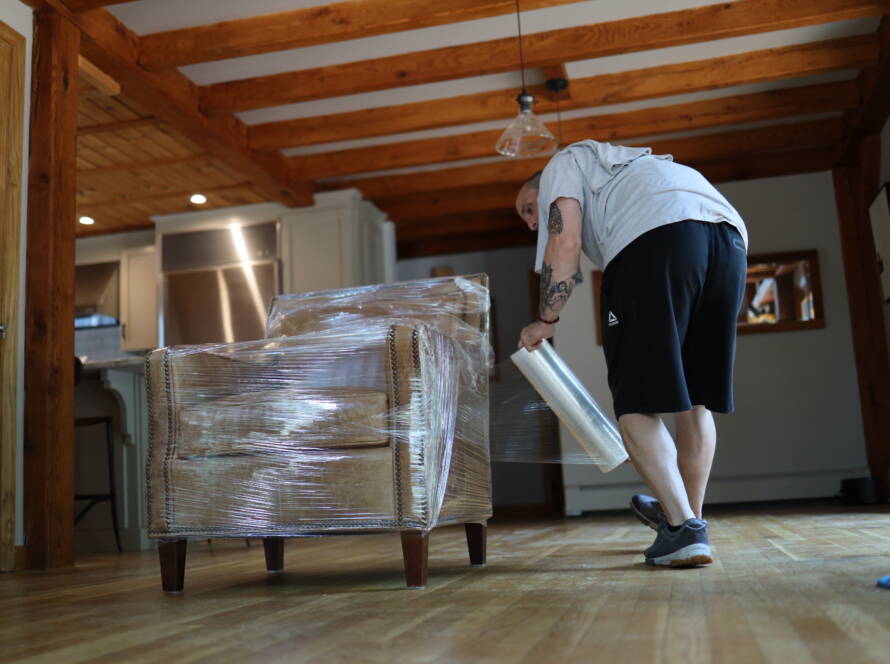
Furniture blankets and corner protection protect both the furniture and the walls and stair railings from impact during navigation. On a tight staircase, contact between furniture and the surrounding structure is nearly unavoidable — the question is whether that contact causes damage.
Team coordination on angles. Moving a sofa or mattress around a stair landing often involves a specific sequence of angles — tilting, rotating, and repositioning the piece as it goes around the corner. Professional crews have done this hundreds of times and know the sequence. First-time DIY movers are figuring it out in real time, often under the physical strain of holding the piece.
Assessment before starting. Economy Movers’ crews do a walkthrough of the staircase situation before beginning rather than discovering complications mid-carry. If a piece won’t fit the staircase, the team identifies that early and problem-solves before the furniture is partially up the stairs.
What to Communicate to Your Movers Before Moving Day
The more your moving crew knows about your staircase situation in advance, the better prepared they arrive. When you’re scheduling or confirming with Economy Movers, flag:
- Number of floors and staircase flights at origin and destination
- Width of staircase and any tight landings or turns
- Any large furniture pieces — sectionals, king beds, tall bookshelves, large wardrobes — that may present challenges
- Whether there’s elevator access as an alternative at either property
- Any restrictions the building has on staircase use for moving (some Rhode Island apartment buildings have rules about which staircase may be used for moving)
This information helps the crew plan the right team size, bring the appropriate equipment, and schedule accurate time for the job.
Furniture That May Not Fit the Staircase
Sometimes the honest answer to a staircase problem is that a specific piece of furniture simply won’t navigate the stairs — not because of equipment or technique, but because of geometry. A very large sectional sofa, an oversized wardrobe, or a piece of custom furniture built to fit a previous home may not physically turn the corner of a tight Rhode Island staircase.
When this happens, the options are: disassembly (many furniture pieces can be broken down to components that fit individually), window removal (in some cases, furniture can be hoisted or passed through a window on upper floors — a more involved process that requires specific rigging), or accepting that the piece won’t be coming with you.
Economy Movers has dealt with every version of this scenario across Rhode Island homes for decades. Contact the team if you have specific concerns about a piece of furniture and a specific staircase situation — a direct conversation before moving day is far better than a surprise on the day itself.
Pricing for Staircase Moves
Most moving companies — including professional movers in RI — include a standard number of stair flights in their base pricing and apply a stair carry surcharge for additional flights beyond that. This is standard practice in the industry and reflects the real additional time and labor involved.
When you request an estimate from Economy Movers , describe your stair situation accurately so the estimate reflects the actual job. An estimate based on a single-floor, flat-access move will be different from one that accounts for three flights of stairs — and the final bill should match the estimate, not surprise you on moving day.